Crowley’s path to the Abyss, measured by waking, dream and dreamless sleep.
Crowley said he crossed the Abyss. This is not an attempt to judge him. It is a reading of his own words, slowly, beside the three states that the old traditions have always used to map awakening: waking, dream and dreamless sleep. Read this way, a pattern shows through all of his records: he comes to the edge of the dreamless, and returns to dream.
What crossing is
To cross the Abyss is really two movements. The first is to go into the dreamless awake, into the dark that dissolves, and to stay there. In that darkness the seeker and the Holy Guardian Angel become one. You no longer hear the Angel; you are the Angel. The second movement is the fourth: waking, dream and dreamless sleep flow together into one awareness, and that awareness is lived in the body, by day and by night.
The traditions say it simply. The Vijñānabhairava Tantra describes the moment when sun and moon dissolve into the great sky: some fall into something like deep sleep, but “the awakened, however, remain lucid.” It speaks of holding all three states as one: “Knowing these states as the very form of Bhairava, one holds infinite light.” And the Avadhūta who has gone beyond “never dreams, for he always remains the same during day and night.”
The Taoists say the same. The Zhuangzi describes the sage in a single line: “The True Man of ancient times slept without dreaming and woke without care.” And the Cantong qi, the oldest text of Chinese alchemy, points to the state to rest in, “serene and quiescent in Empty Non-Being,” and warns against practices that go astray into visions, apparitions “at whose sight in your dreams you sigh with emotion.” The way does not lead into brighter dreams. It leads through them, into emptiness.
The dreamless is not empty. As you enter it, information comes, and the subtler layers of consciousness open, good and bad, heaven and hell: the whole of who you are. Knots form and dissolve. Fear rises as the self loosens. The work is to stay the watcher through all of it, not to grasp, not to be pulled back. At the far end of the crossing sit the Secret Chiefs. But they are not beings you meet there. They are what you become: the wisdom and the information itself.
Dream is different. Dream is the place of images, voices and figures, however holy; and to see them clearly is to be awake in the dream. No map of consciousness can prove anything on its own. But in every tradition that charts these states, visions and the astral belong to the dream. That is the gentle question to carry through Crowley’s writing: when the dark opened, did the watcher stay, or did the images return?
It is an old question. The Upaniṣads lead the student through the self of waking, of dream and of deep sleep, and point beyond them to the fourth. The Tantras, the Tibetan yogas of dream and sleep, and the Avadhūtas all ask the same thing. And Crowley asked it too, when he wrote that sleep had become “the same as waking.”
Part I · John St. John
Paris, October 1908 · never so far, never so near
In the autumn of 1908 Crowley shut himself in a room in Paris for thirteen days, to call his Holy Guardian Angel, whom he named Adonai. He wrote down every hour. It is one of the most honest records of practice ever kept, and from the first pages the shape of it is clear. The Angel keeps opening to him, and he keeps missing Him.
The Light begins to come, “but the Perfume and the Vision came not.” In the ritual the Angel appears at last, “yet was He seen as from afar, not intimately.” Crowley prays to pursue Him anywhere, even into “the Flames of the Abyss… Thee will I overtake.” It is a beautiful prayer, and it is a seeker’s prayer: someone reaching out for something that is still outside.
Then the Pit opens. In a flash he sees his whole life as a “pose,” even his love of truth put on for his biographer. “It is The thought that murders the soul.” He knows how he fell: “this subtle self-satisfaction that lost me.” That night horror and brilliance come together, as the twin giant heads of the Qliphoth, and he writes the line that sums up the whole retreat: “I was never so far, and never so near.”
These are glimpses of the void in the gaps between the images, the Abyss felt from inside the dream. And each time, he takes hold of them. The heralds of his Lord become shapes, Khephra, the Rosy Cross, the giant heads, and “never so far, never so near” is a distance still being measured by someone. When the images thin out altogether, he sleeps. “A complete annihilation of all thought,” he writes, and then he “went off again to sleep.” He sees it himself: “I was perfect, had I only watched.”
On the twelfth day he passes “into nothing,” wrapped in “the black brilliance of my Lord,” and writes that “sleep is the same as waking.” The next morning’s entry is quietly revealing: “Awoke from long sweet dreamless sleep.” You only wake from the dreamless if you were not there in it. The awakened remain lucid; he had slept. And the last day opens with a longing rather than a report: “Being entered into the Silence, let me abide in the Silence!”
Part II · The Vision and the Voice
The Tenth Aethyr
ZAX · the Abyss · Bou Sâada, 6 December 1909
A year later Crowley was in the Algerian desert with Victor Neuburg as his scribe, calling the thirty Aethyrs one by one. The tenth is the Abyss itself, and its guardian is Choronzon. Crowley sat apart, wrapped in his black robe, in a place “where is neither sight nor hearing,” and through the whole ceremony he “did not move or speak.” Everything we have of that day was heard and written by Neuburg.
The Cry opens with the right words: “There is no being in the outermost Abyss, but constant forms come forth from the nothingness of it.” And then the forms come pouring: a courtesan from Paris, a holy man, a serpent, a demon begging for water. Choronzon names them himself: “Images, images, images, all without control.”
Choronzon is not the dreamless. He lives in the gaps between, in the spaces between the images where Crowley could see and feel the void, the Abyss glimpsed from inside the dream and then filled at once with shapes. He is the mind that cannot let go: “Dispersion,” “millions of mad voices in my brain.” Twice the voice speaks “in the natural voice of the Frater.” Someone is still there, still speaking.
And the visions are full of fear. As the dreamless comes near, fear rises: the fear of not being. Crowley would have felt it, and Choronzon gives it words: “Knowest thou that in my soul is utmost fear?” “A hundred times have I been ready to leap, and for fear have missed.” It is the fear at the door. The leap is missed, and the gap fills again with forms.
Choronzon even says what is missing: Crowley “might learn at length to dare, but that to keep silence he should never learn.” And it is Neuburg, not Crowley, who discovers the key: “Choronzon feareth of all things concentration and silence.” The Aethyr ends with the claim that “the present Seer… hath no name,” and with a magical act: the seer writes BABALON with his ring, and Choronzon is gone. A form, sent away by a form.
The First Aethyr
LIL · the last of the thirty
And then, at the very end of the thirty, something different happens. For the first time in all his records, he begins to dissolve. “There is no tendency of any sort, much less any observation or feeling or impression. There is only a faint consciousness, like the scent of jasmine.” “A waking sleep that is deeper than sleep.” “I have forgotten where I am, and who I am. I am hanging in nothing.”
It is his first true moment of dissolution. And then he is pulled back into dream. “Now the veil opens of itself.” At once he is speaking to his scribe again, and the images return, greater than ever: a child covered with lilies and roses, countless Archangels, and on the child’s forehead “the secret sigil of the Beast,” his own sign. He even feels the pull: “There is another forcing my head down in sleep.”
“I am hanging in nothing.” Then: “Now the veil opens of itself.”
Dissolving does not end in a vision. If the self had gone, there would be no one left for the child to appear to, no one to be led, no one to be named. In the very moment of dissolving, the seer was still there, and the dream returned.
The Cantong qi had warned of exactly this: visions that come in the dream, at whose sight one is moved. The glory of the child is real as an experience. But it is a dream returning, not the emptiness it interrupted.
Look where the return lands: “FOR I AM HORUS, THE CROWNED AND CONQUERING CHILD,” and the vision gives him a mission, to proclaim a new Aeon. Horus is the god of the Book of the Law, which Crowley had received five years before. At the edge of the dreamless the self does not fight. It simply gathers itself around the greatest part it can find. “I have forgotten who I am” becomes, a few lines later, a man with a mission and a name.
Part III · The Book of the Law
Liber AL vel Legis · Cairo, 1904 · read beside the Thelema map
The Book of the Law came from across the Abyss. Crowley was only its scribe, and the voice names where it comes from: “revealed by Aiwass the minister of Hoor-paar-kraat.” Hoor-paar-kraat is Harpocrates, the god of silence, the finger to the lips. The book was spoken from the far side by the minister of the very silence Choronzon said he would never learn.
Crowley later came to see Aiwass as his own Holy Guardian Angel. That changes the whole story. The voice from beyond the Abyss was his own deepest self. And the crossing is not to hear the Angel but to become it. Conversation is still two, a voice and a listener; in the dreamless that conversation ends, and in the fourth the union is lived. Yet Crowley stayed the scribe. In Cairo he took dictation. In Paris the Angel was “seen as from afar.” In the desert it was always “my Lord.” Even at the door of the dreamless the child appeared to him and gave him a role. The same is true of the Secret Chiefs, whom he sought all his life as hidden masters elsewhere. They sit at the end of the crossing, and one does not meet them there; one becomes them. As long as they speak to you, you have not yet reached the end.
The oldest Western account of meeting the Angel tells the same story more gently. In the first book of the Hermetica, the Poimandres, Hermes is lying still, “my thinking soared high and my bodily senses were restrained, like someone heavy with sleep,” when a great presence comes to him: “I am Poimandres, mind of sovereignty; I know what you want, and I am with you everywhere.” The guide appears at the edge of sleep, just as Adonai and Aiwass came to Crowley. But Poimandres does not stay outside. He tells Hermes that the mind within him “is god the father,” and that “he who has understood himself advances toward god.” And the journey he teaches does not end in hearing the guide. It ends in becoming: “This is the final good for those who have received knowledge: to be made god.”
On the way, the soul gives back at every sphere what it had carried, until, “having become powers, they enter into god.” And Hermes turns back to the world with a call to wake: “People, earthborn men, you who have surrendered yourselves to drunkenness and sleep and ignorance of god,” become sober. In the Hermetica, sleep is the ignorance itself.
When Hermes returns, he describes himself in words that could stand for the whole of the fourth: “the sleep of my body became sobriety of soul, the closing of my eyes became true vision, my silence became pregnant with good.” Sleep that has become wakefulness. Silence that is full. It is everything Crowley reached toward in Paris and in the desert, and kept slipping from: the morning he awoke from dreamless sleep, and the silence Choronzon said he would never learn.
Read beside the map of awakening, the book is a guide inward. It is even written from the top down: Nuit, the beyond, in Chapter I; Hadit, the fourth, in Chapter II; Ra-Hoor-Khuit, the crowned child of the dream, in Chapter III. The path climbs the other way. It begins with the Law, “Do what thou wilt,” not as permission but as the task of finding the one will that is yours, the star in each of us. It passes through the Child and the Angel. It meets the Abyss, with its danger, “the pit called Because,” and its way through, “the pain of division is as nothing, and the joy of dissolution all.” It comes to Hadit, “the flame that burns in every heart,” and to the line that holds the whole of the fourth: “all the sorrows are but as shadows; they pass & are done; but there is that which remains.” And beyond it all, Nuit, Infinite Space, whose will is “pure will, unassuaged of purpose, delivered from the lust of result.” “My colour is black to the blind,” she says, “but the blue & gold are seen of the seeing.” The void is not empty. It is only unseen.
Crowley built his life on Chapter III, the Child and the Aeon. And that is exactly where he landed, again, in the First Aethyr.
Wake up
Read straight through, the Book of the Law keeps saying one thing: wake up. And as it goes on, you can feel it growing frustrated with the one who wrote it down.
In the first chapter Nuit shows the way. Her sign is “the consciousness of the continuity of existence,” awareness unbroken through every state. And she gives the method: under the night stars in the desert, with a pure heart, “thou shalt come a little to lie in my bosom. For one kiss wilt thou then be willing to give all; but whoso gives one particle of dust shall lose all in that hour.” Give all, not a particle less. Five years later, in that same desert, Crowley wrote that every particle of his personality had been consumed. Within days the self was back.
In the second chapter Hadit tells him to stop seeking: “‘Come unto me’ is a foolish word: for it is I that go.” And then the frustration begins. “O prophet! thou hast ill will to learn this writing.” “Because of me in Thee which thou knewest not. for why? Because thou wast the knower, and me.” Hadit was in him all along, and he could not see it, because he stood in the place of the one who knows. The chapter closes: “Thou knowest not; nor shalt thou know ever.”
By the third chapter the book looks past him: there are “mysteries that no Beast shall divine. Let him not seek to try: but one cometh after him.” And near the end, almost wryly: “The fool readeth this Book of the Law, and its comment; & he understandeth it not.” The comment was Crowley’s own.
Part IV · What He Wrote Later
the 1906 diary · the introduction to The Vision and the Voice · the Confessions
Crowley wrote about these times again later, and told them more grandly. But even there the same pattern shows through.
In October 1906, after his invocation of the Angel, he wrote in his diary that the ritual brought him “very close to samadhi.” He “did get rid of everything but the Holy Exalted One, and must have held Him for a minute or two.” He wondered whether the hashish he had taken, or his fear of his wife arriving, had stopped him going further. Close to, not in. Holding Him, so still two. A minute, and then back.
Of the desert, in his introduction to The Vision and the Voice, he wrote that he had “astrally identified” with Choronzon, and that on the mountain a sacrifice consumed “every particle of my personality.” Of the walk back to Bou Sâada he remembered nothing: “There was an animal in the wilderness, but it was not I.” It is a striking line. But “astral” is his own word for the world of images, and to remember nothing is not the same as remaining lucid. It sounds much like that morning in Paris: waking from dreamless sleep, not having been there in it. And within days the personality he said was consumed came back, larger, in the First Aethyr.
Years later, in the Confessions, he wrote of himself that he had “got rid of his sense of the personal self, yet his force was discharging itself dispersedly through all sorts of channels.” Dispersion: the very word Choronzon used for himself.
On the maps
Placed on the Western maps of awakening, his records gather in the same place.
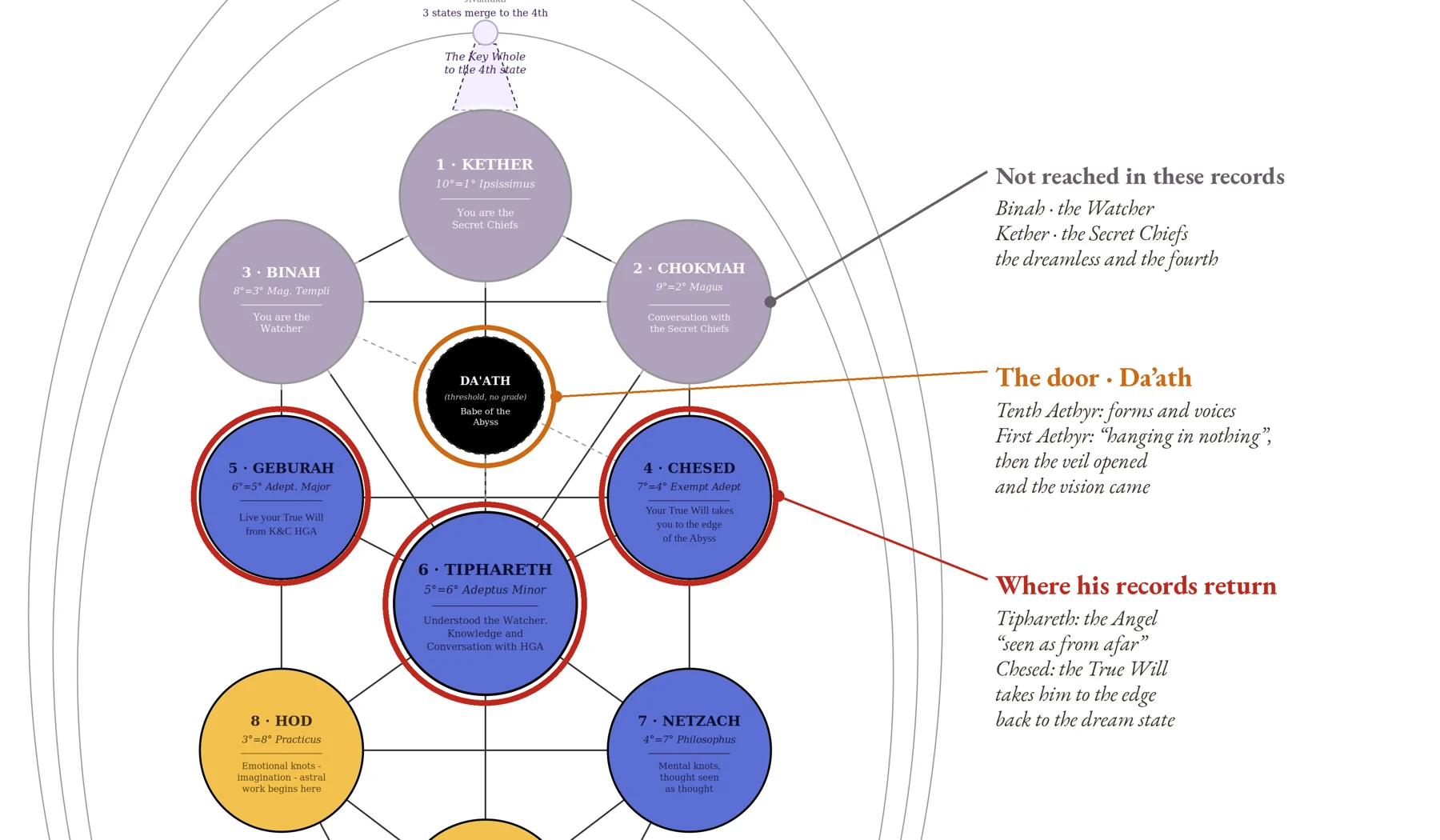
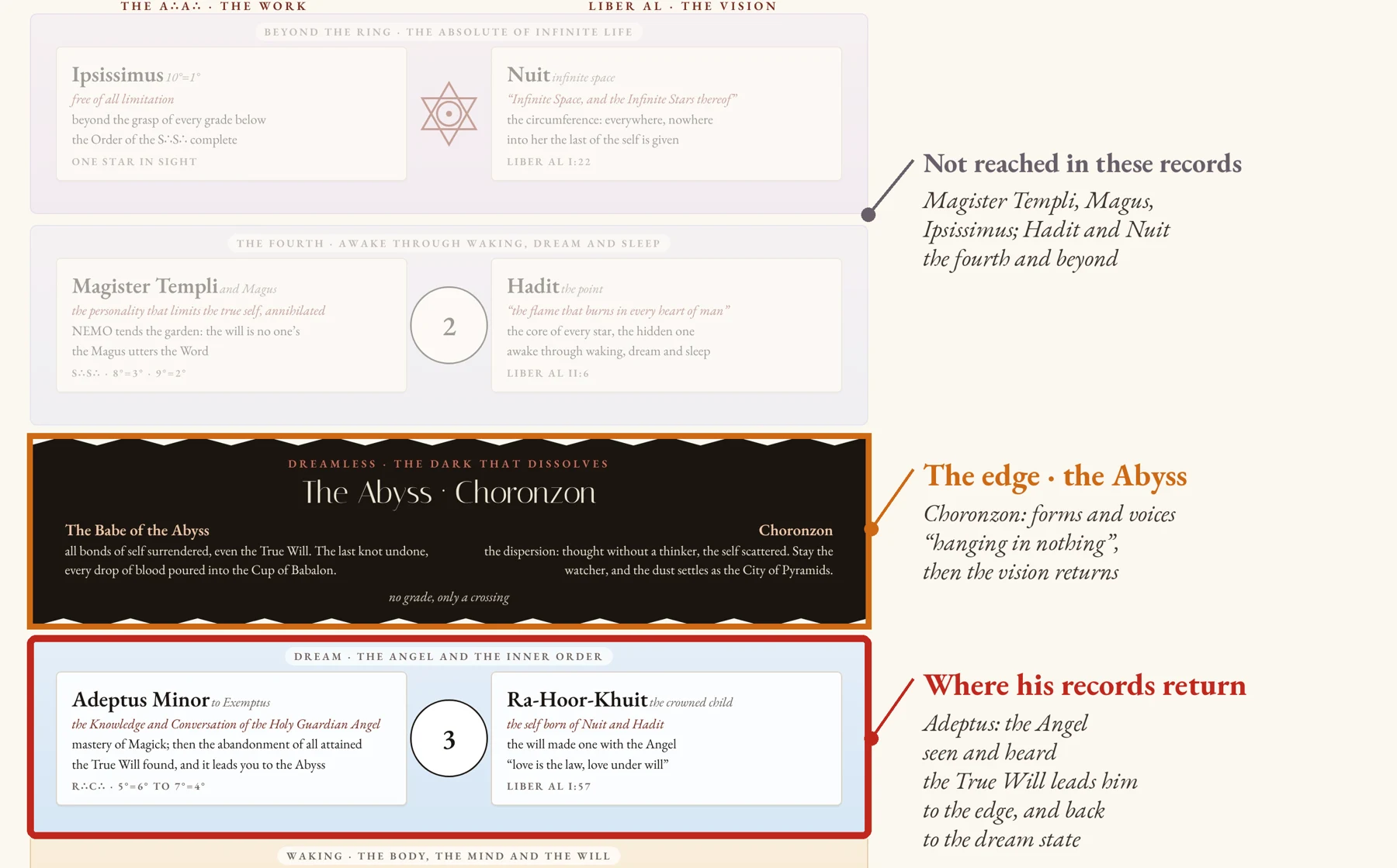
Always two
Through all of it, Crowley lived in two. In Paris, the seeker and Adonai, “Thou” and “I.” In the desert, the seer and the scribe, the circle and the triangle, the magician and the demon. In the First Aethyr, the child and the one led to him, the god and the one he sends. In Cairo, Aiwass and the hand that wrote. The book he received names both the condition and the cure: “I am divided for love’s sake, for the chance of union.” Division is the dream. In the dreamless the two become one, and in the fourth that oneness is lived. Crowley lived inside the division all his life, and wrote it down more beautifully than almost anyone.
Kenneth Grant and the gaps between
Kenneth Grant, who was Crowley’s secretary in his last years and carried his current on, returned often to the three states. In Beyond the Mauve Zone he writes simply: “Deep sleep is therefore the gateway to our Reality; we could not know any other.” And he says something that sheds quiet light on everything above. The very idea of an abyss, he writes, “arises in the waking state from this apparent hiatus in consciousness”: from the gaps between waking, dream and dreamless sleep.
That is exactly where Crowley met his Abyss: in the gaps, the spaces between the images, where the void could be seen and felt, and where Choronzon rose to fill them. Grant points past the gap to what lies beneath all three states, “the bodiless and mindless consciousness that is their substratum and their sole reality,” and to “the dissolution of the seed of consciousness into its void substrate.” And he writes of the Mauve Zone, the region beyond, as a place that earlier seekers approached, touched, and retreated from; very few, he says, “have penetrated beyond it and survived.” It reads like a description of Crowley himself.
Knots that re-form
There is one more way to see all of this. The path to the dreamless is a loosening of knots, the knots of the self, one by one. As you come near the dark, they begin to dissolve. But a knot that is only loosened, and not seen through, re-forms. It ties itself again, often around something new.
Crowley’s records show this happening throughout. In Paris the knot loosened into “nothing,” and re-formed as self-satisfaction at the heralds of his Lord. In the desert it loosened in the gaps, and re-formed as an argument with Choronzon. In the First Aethyr it came closest to dissolving, “I have forgotten where I am, and who I am,” and re-formed in a single breath as a crown and a mission. Each time the knot came back, it came back a little larger.
The work is not to fight the knots, nor to cut them, but to stay the watcher as they form and dissolve, non-sticky. The last knot is the one who is watching for the Angel. When that one loosens, the dark opens all the way through, and the dreamless is entered awake. Even then, a knot that has gone is not always gone for good.
Coming back to yourself
Jan Fries spent months travelling the Nightside of the Tree, with Crowley’s own maps in hand, and he writes about Crowley’s crossing without awe. When Crowley, “as he claimed ‘crossed the Abyss’ he was in a desperate hurry to get it over with”: Choronzon one day in the desert, a Babe of the Abyss the next. “It simply wasn’t good enough.” In truth, Fries says, “you can never say that you ‘crossed the Abyss’, as the Abyss is all-inclusive.”
His own account shows what the return looks like when it is not hurried. He would shed “the layers and layers of myself until I became very simple and almost completely absent.” He saw “‘my’ Holy Guardian angel die” and felt “‘my’ gods disintegrate.” And then he came back, to the world, the body, the personality, and found the same self waiting. “Gradually, ‘I’ began to accept that functioning on Planet Earth is easier when a convenient personality holds awareness together.” The personality returned, with much the same habits and conditioning, but it was now seen for what it is, “a convenient hallucination,” fragile and artificial.
He puts the whole matter in a few lines:
“When You returns, if only to live, work, celebrate, meet friends, or play with the kids, the Abyss is instantly back again. It comes in one package with the ego (the sense of identification) and is never more than a shadow’s breadth away.”
This is the return from a visit to the Abyss. You come back to yourself, to a self shaped by the same conditioning, and the knots begin to form again. Soror Nema, whom Fries quotes, says it simply: “The Abyss is crossed by minutes every day.” For as long as there is someone who goes in and comes back, there is an Abyss to cross.
A Nath avadhuta, a living teacher of that old line, put it to me this way:
“As they say in West Africa, no condition is permanent… People often have periods of relative awakeness, but the needs of society, the world and wrong thinking can be powerful to rob them again. I don’t exclude myself from that. It is a constant battle.”
The return that completes the Great Work is different. Completion is the fourth. Awareness has moved through waking, dream and dreamless sleep and is present in all three, so on the way back there is no Abyss to cross. But the one who returns still carries the old conditioning: the habits, the reactions, the shape of a life lived in a world built on rapport and expectation. The same avadhuta is plain about this too: “we naturally adapt to our situation, and where something in our world changes, it is possible to lose elements of our awakened state.” Nor can it be assumed “that once a knot has gone, that it will not reform, which is not always the case!” Completion does not end the watching. It changes where the watching is done from.
Crowley’s story is neither of these. He did not return, because he never crossed; he never even stepped properly into the Abyss. He came to its edge, and each time the self pulled back into dream and took a new name. Fries sees the cost: “a brilliant but highly flawed supreme adept who spent the rest of his life being tossed about by fits of megalomania.”
Always back to dream.
In Paris he woke from dreamless sleep. In the Tenth Aethyr forms poured out of the nothing, and fear missed the leap. In the First he began, for a moment, to dissolve, and was pulled back into a vision that gave him a crown and a mission. And all the while the Book of the Law was telling him how to wake.
He came to the edge many times, and each time the self came back a little larger. That is no small thing; very few come so near. But the book he carried, read the other way, inward and upward, still points the road for anyone who would go further. Stay the watcher. Give all. Let the images pass. “The awakened, however, remain lucid.”
See also The Tale of the Two Voids and the Thelema map, The Path of the Star.
There is that which remains.
The Book of the Law · II:9Bibliography
Aleister Crowley
Crowley, Aleister. John St. John: The Record of the Magical Retirement of G. H. Frater, O∴M∴. Supplement to The Equinox, vol. I, no. 1. London, 1909.
Crowley, Aleister. The Vision and the Voice (Liber XXX Aerum vel Saeculi, sub figura CCCCXVIII). In Aleister Crowley, The Practice of Enochian Magick, introduced by Lon Milo DuQuette. Newburyport, MA: Weiser Books, 2020. First published as a supplement to The Equinox, vol. I, no. 5. London, 1911.
Crowley, Aleister. Liber AL vel Legis: The Book of the Law. Received in Cairo, April 1904; first published 1909.
Crowley, Aleister. One Star in Sight. In Magick in Theory and Practice. Paris: Lecram Press, 1929.
Crowley, Aleister. The Confessions of Aleister Crowley: An Autohagiography. Edited by John Symonds and Kenneth Grant. London: Jonathan Cape, 1969.
Crowley, Aleister. Diary, 10 October 1906. Transcribed at Aleister Crowley Timeline, aleistercrowleytimeline.com.
The traditions
Copenhaver, Brian P., trans. Hermetica: The Greek Corpus Hermeticum and the Latin Asclepius in a New English Translation, with Notes and Introduction. Cambridge: Cambridge University Press, 1992.
Dyczkowski, Mark S. G., trans. Vijñānabhairava Tantra, with the commentary of Ānandabhaṭṭa. (Ānandabhaṭṭa quoted from p. 211; verse 86 rendered from the Sanskrit.)
Olivelle, Patrick, trans. Saṃnyāsa Upaniṣads: Hindu Scriptures on Asceticism and Renunciation. New York: Oxford University Press, 1992. (Turīyātītāvadhūta Upaniṣad.)
Olivelle, Patrick, trans. Upaniṣads. Oxford World’s Classics. Oxford: Oxford University Press, 1996. (Chāndogya and Māṇḍūkya Upaniṣads.)
Pregadio, Fabrizio, trans. The Seal of the Unity of the Three: A Study and Translation of the Cantong qi. Mountain View, CA: Golden Elixir Press, 2011.
Watson, Burton, trans. The Complete Works of Zhuangzi. New York: Columbia University Press, 2013.
Commentary
Fries, Jan. Nightshades: A Tourist Guide to the Nightside. Oxford: Mandrake of Oxford, 2012. Includes “Across the Abyss” and pp. 59–62; quotes Nema, Liber Pennae Praenumbra.
Grant, Kenneth. Beyond the Mauve Zone. London: Starfire Publishing, 1999.
Via Foramen
The Tale of the Two Voids. viaforamen.com/essays/the-tale-of-the-two-voids.
Quotes of the Fourth and Quotes of Awakening. viaforamen.com.
Maps of Awakening: the Tree of Life and The Path of the Star. viaforamen.com/maps-of-awakening.